 DocsTopicsSearch docsAPI referenceDocsTopicsSearch docsAPI reference
Architecture
A new route on disk has to reach a runtime registry before a request can use it. Follow the generator from the module scan to the files your application loads.
yarn generate is the registry compiler for Open Mercato. It scans enabled modules, applies built-in generator extensions, loads optional module-declared plugins, and emits the generated files consumed by routing, DI bootstrap, CLI dispatch, widgets, notifications, search, and other runtime registries.
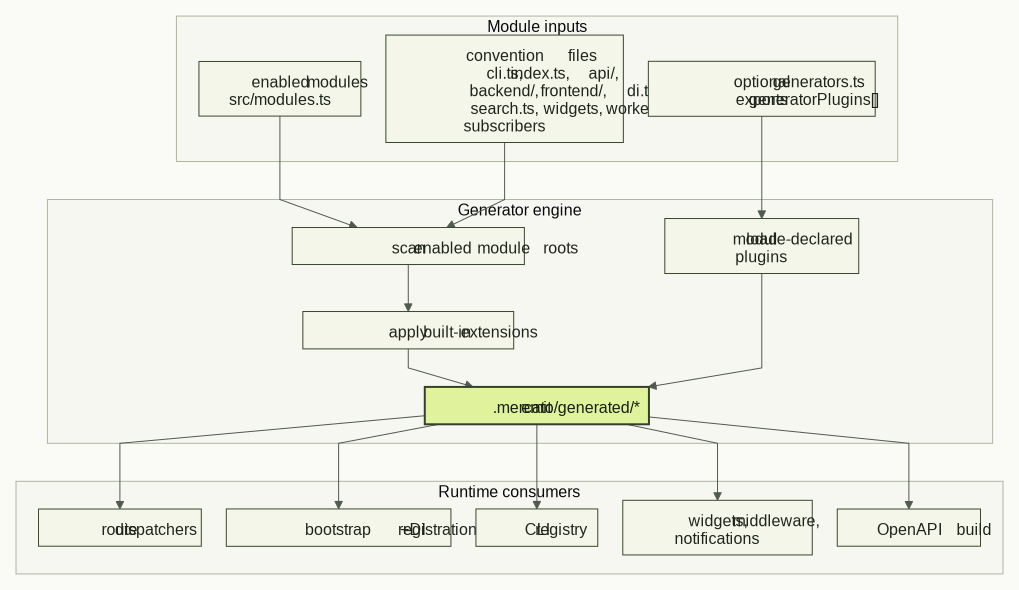
flowchart TD
  subgraph Inputs["Module inputs"]
    modules["enabled modules<br/>src/modules.ts"]
    conventions["convention files<br/>cli.ts, index.ts, api/, backend/, frontend/, di.ts, search.ts, widgets, workers, subscribers"]
    plugins["optional generators.ts<br/>exports generatorPlugins[]"]
  end

  subgraph Engine["Generator engine"]
    scan["scan enabled module roots"]
    builtins["apply built-in extensions"]
    modulePlugins["load module-declared plugins"]
    emit["emit .mercato/generated/*"]
  end

  subgraph Runtime["Runtime consumers"]
    routes["route dispatchers"]
    bootstrap["bootstrap + DI registration"]
    cli["CLI registry"]
    ui["widgets, middleware, notifications"]
    openapi["OpenAPI build"]
  end

  modules --> scan
  conventions --> scan
  plugins --> modulePlugins
  scan --> builtins --> emit
  modulePlugins --> emit
  emit --> routes
  emit --> bootstrap
  emit --> cli
  emit --> ui
  emit --> openapi

    classDef focus fill:#e0f29c,stroke:#34402d,color:#172011,stroke-width:2px
    class emit focus
Open Mercato uses two additive extension layers during generation:
packages/cli/src/lib/generators/extensions/generators.ts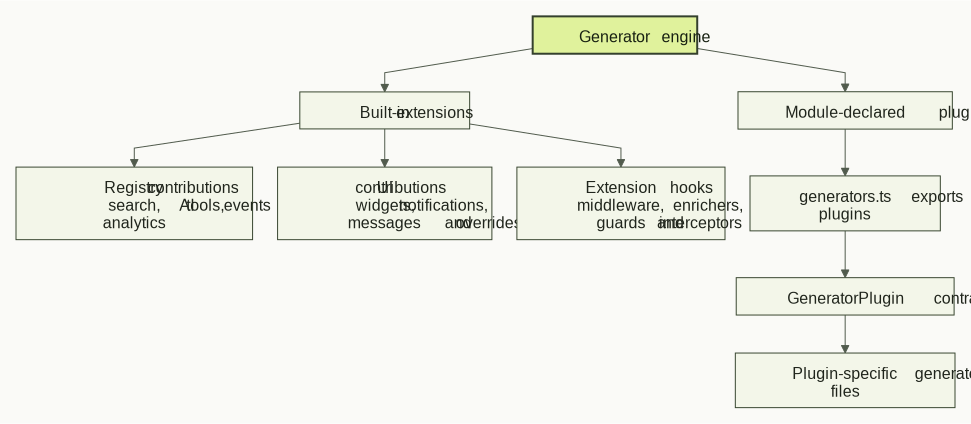
flowchart TD
  root["Generator engine"] --> built["Built-in extensions"]
  root --> custom["Module-declared plugins"]
  built --> registry["Registry contributions<br/>search, AI tools, events and analytics"]
  built --> ui["UI contributions<br/>widgets, notifications, messages and overrides"]
  built --> intercept["Extension hooks<br/>middleware, enrichers, guards and interceptors"]
  custom --> exports["generators.ts exports plugins"]
  exports --> contract["GeneratorPlugin contract"]
  contract --> output["Plugin-specific generated files"]
    classDef focus fill:#e0f29c,stroke:#34402d,color:#172011,stroke-width:2px
    class root focus
These are framework-owned registries that every app can rely on without extra plugin authoring:
Modules can extend generation without editing the generator package by exporting generatorPlugins from generators.ts.
Plugin contract summary:
| Field | Meaning |
|---|---|
id | Unique registry/plugin family ID |
conventionFile | Module-local file to scan for plugin entries |
importPrefix | Prefix for generated import variable names |
configExpr(importName, moduleId) | Expression that turns a discovered module file into one generated entry |
outputFileName | Generated file produced by the plugin |
buildOutput(...) | Function that renders the generated TypeScript source |
bootstrapRegistration | Optional bootstrap-time registration contribution |
This is what keeps generator architecture additive: new registry families can ship as module-owned plugin definitions rather than as hard-coded cases in the root generator.
These are the primary generated files emitted by the core generator pipeline.
| Generated file | Purpose |
|---|---|
modules.generated.ts | Full discovered module graph, including rich runtime metadata used by framework registries and compatibility paths. |
modules.runtime.generated.ts | Runtime-focused module registry used by the current lightweight bootstrap/runtime path. |
modules.app.generated.ts | App bootstrap registry used by application startup without route-heavy coupling. |
modules.cli.generated.ts | CLI module registry loaded by yarn mercato for module-owned commands. |
cli-modules.generated.ts | Convenience export/wrapper around the generated CLI module list. |
bootstrap-modules.generated.ts | Bootstrap-oriented module registry helpers used during startup assembly. |
bootstrap-registrations.generated.ts | Generated bootstrap registration calls, including optional plugin-contributed registrations. |
entities.generated.ts | MikroORM entity registry for discovered modules. |
entities.ids.generated.ts | Stable generated entity ID constants. |
entity-fields-registry.ts | Generated entity-fields registry used by encryption and related metadata consumers. |
di.generated.ts | Discovered DI registrars for enabled modules. |
frontend-routes.generated.ts | Frontend route manifest with lazy route-loading metadata. |
backend-routes.generated.ts | Backend route manifest with lazy route-loading metadata. |
api-routes.generated.ts | API route manifest with method/path metadata and lazy handlers. |
subscribers.generated.ts | Legacy/generated subscriber registry compatibility file. |
openapi.generated.json | Generated OpenAPI document built from discovered API routes and route metadata. |
module-package-sources.css | Generated stylesheet that tracks module package source markers for runtime styling/diagnostics. |
These generated files come from built-in generator extensions.
| Generated file | Source extension | Purpose |
|---|---|---|
search.generated.ts | search | Search module config registry. |
notifications.generated.ts | notifications | Notification type registry. |
notifications.client.generated.ts | notifications | Client-side notification renderers. |
payments.client.generated.ts | notifications | Payment-related notification/client adapters. |
notification-handlers.generated.ts | notifications | Reactive notification side-effect handlers. |
message-types.generated.ts | messages | Message type registry. |
message-objects.generated.ts | messages | Message object registry. |
messages.client.generated.ts | messages | Client-side message object renderers/adapters. |
ai-tools.generated.ts | ai-tools | AI/MCP tool registry. |
events.generated.ts | events | Event definitions and event registry metadata. |
analytics.generated.ts | analytics | Analytics/dashboard configuration registry. |
translations-fields.generated.ts | translatable-fields | Translatable field declarations by module/entity. |
enrichers.generated.ts | enrichers | Response enricher registry. |
interceptors.generated.ts | interceptors | API interceptor registry. |
component-overrides.generated.ts | component-overrides | UI component override registry. |
inbox-actions.generated.ts | inbox-actions | Inbox action registry. |
guards.generated.ts | guards | Mutation/page/runtime guard registry. |
command-interceptors.generated.ts | command-interceptors | Command interceptor registry. |
frontend-middleware.generated.ts | page-middleware | Frontend page middleware registry. |
backend-middleware.generated.ts | page-middleware | Backend page middleware registry. |
dashboard-widgets.generated.ts | dashboard-widgets | Dashboard widget registry. |
injection-widgets.generated.ts | injection-widgets | Injection widget registry. |
injection-tables.generated.ts | injection-widgets | Injection table/slot registry. |
The cache command is a normal cli.ts discovery case, not a generator plugin. It is documented separately in Cache CLI architecture. That page focuses on cache-specific runtime behavior, while this page documents the broader generator system that makes module-owned commands discoverable.
Previous: Platform roadmap and release status · Next: Glossary