 DocsTopicsSearch docsAPI referenceDocsTopicsSearch docsAPI reference
Framework
Take a rule such as “send large orders for review.” The engine first needs the facts about the order, then a condition that can evaluate those facts, and finally an action with an observable outcome. Each part has a different place in the implementation.
The Business Rules module follows Open Mercato's modular architecture pattern, with clear separation between data, services, UI, and API layers.
packages/core/src/modules/business_rules/
├── index.ts                    # Module metadata
├── acl.ts                      # RBAC feature definitions
├── di.ts                       # Dependency injection registrations
├── data/
│   ├── entities.ts            # MikroORM entities (4)
│   ├── validators.ts          # Zod schemas
│   └── extensions.ts          # Entity extensions
├── lib/
│   ├── expression-evaluator.ts    # Condition evaluation
│   ├── rule-evaluator.ts          # Rule discovery and evaluation
│   ├── action-executor.ts         # Action execution
│   ├── rule-engine.ts             # Orchestration layer
│   ├── value-resolver.ts          # Field and special value resolution
│   └── payload-validation.ts      # Server-side validation
├── components/
│   ├── ConditionBuilder.tsx       # Visual condition builder
│   ├── ActionBuilder.tsx          # Visual action builder
│   └── formConfig.tsx             # Form configuration
├── backend/                       # Admin UI pages (8)
├── api/                           # REST API endpoints (13)
├── migrations/                    # Database migrations (3)
├── i18n/                          # Translations (EN, PL)
└── __tests__/                     # Test suites
The engine uses pure functions over classes for core logic:
Benefits:
Example:
// Pure function - no state, no side effects
export function evaluateExpression(
  expression: ConditionExpression,
  data: Record<string, any>
): boolean {
  // Logic here
  return result
}
Conditions and actions are stored as JSONB in PostgreSQL:
Why JSONB:
Trade-offs:
The Business Rules module is self-contained:
This follows Open Mercato's modular architecture principles.
BusinessRule:
RuleExecutionLog:
RuleSet:
RuleSetMember:
Critical indexes for performance:
-- Rule discovery
CREATE INDEX idx_business_rules_entity_event
  ON business_rules(entity_type, event_type, enabled);

-- Priority ordering
CREATE INDEX idx_business_rules_priority
  ON business_rules(priority DESC, created_at);

-- Tenant isolation
CREATE INDEX idx_business_rules_tenant
  ON business_rules(tenant_id, organization_id);

-- Log querying
CREATE INDEX idx_rule_execution_logs_rule
  ON rule_execution_logs(rule_id, executed_at DESC);

CREATE INDEX idx_rule_execution_logs_entity
  ON rule_execution_logs(entity_type, entity_id, executed_at DESC);
Purpose: Evaluate condition expressions against entity data
Key Functions:
evaluateExpression() - Recursive condition evaluationapplyOperator() - Execute comparison operatorsgetNestedValue() - Resolve field paths with dot notationOperators Implemented (15):
=, ==, !=>, >=, <, <=IN, NOT_IN, CONTAINS, NOT_CONTAINSSTARTS_WITH, ENDS_WITH, MATCHESIS_EMPTY, IS_NOT_EMPTYExample:
const condition = {
  operator: 'AND',
  rules: [
    { field: 'status', operator: '=', value: 'ACTIVE' },
    { field: 'total', operator: '>', value: 1000 }
  ]
}

const result = evaluateExpression(condition, {
  status: 'ACTIVE',
  total: 1500
}) // Returns: true
Purpose: Discover and evaluate applicable rules
Key Functions:
evaluate() - Find and evaluate all applicable rulesevaluateSingleRule() - Evaluate one ruleRule Discovery Algorithm:
Purpose: Execute actions when rule conditions pass/fail
Key Functions:
executeActions() - Execute array of actionsexecuteAction() - Execute single action{{field}} syntaxAction Handlers: Each action type has a dedicated handler function:
async function handleLogAction(action: Action, context: ExecutionContext) {
  const { level, message } = action.config
  const interpolated = interpolateMessage(message, context.data)
  logger.log(level, interpolated)
}
Purpose: High-level orchestration of rule execution
Key Functions:
executeRules() - Main entry point for rule executionfindApplicableRules() - Discover rules to executelogRuleExecution() - Record execution audit trailExecution Flow:
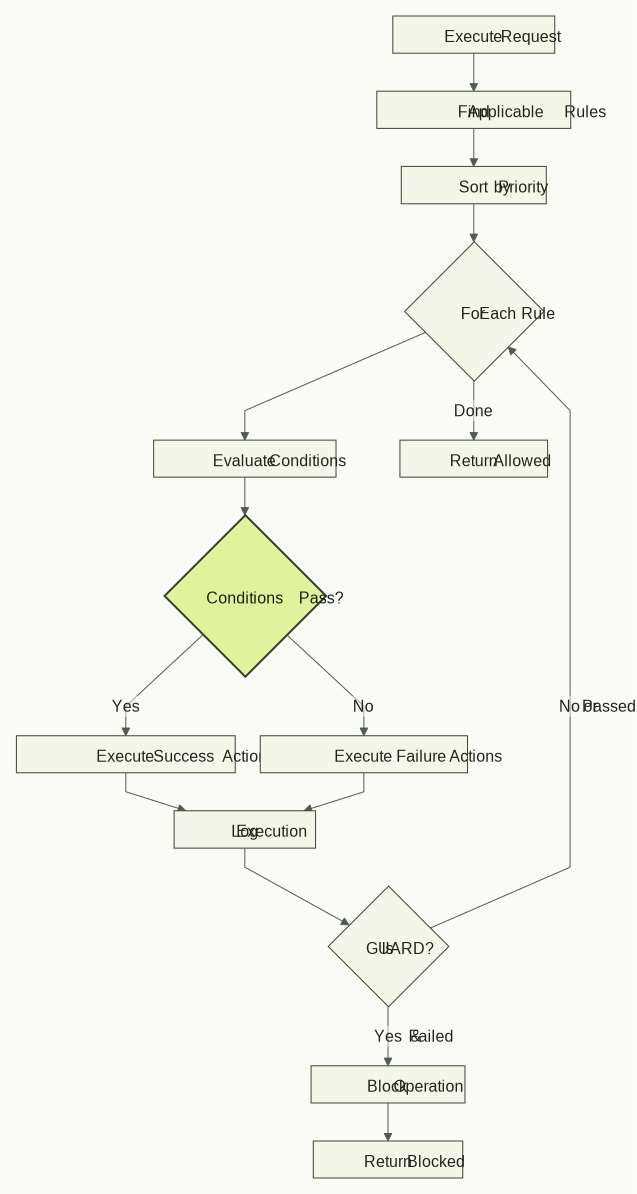
graph TD
  A[Execute Request] --> B[Find Applicable Rules]
  B --> C[Sort by Priority]
  C --> D{For Each Rule}
  D --> E[Evaluate Conditions]
  E --> F{Conditions Pass?}
  F -->|Yes| G[Execute Success Actions]
  F -->|No| H[Execute Failure Actions]
  G --> I[Log Execution]
  H --> I
  I --> J{Is GUARD?}
  J -->|Yes & Failed| K[Block Operation]
  J -->|No or Passed| D
  K --> L[Return Blocked]
  D -->|Done| M[Return Allowed]

    classDef focus fill:#e0f29c,stroke:#34402d,color:#172011,stroke-width:2px
    class F focus
Purpose: Resolve field paths and special values
Key Functions:
getNestedValue() - Access nested properties with dot notationresolveSpecialValue() - Replace special {{tokens}} with dynamic valuesSupported Tokens:
{{today}}, {{now}}, {{yesterday}}, {{tomorrow}}{{user.id}}, {{user.email}}, {{user.name}}{{entity.id}}, {{entity.tenantId}}, {{entity.organizationId}}Purpose: Server-side safety checks
Validations:
Prevents:
All queries automatically scoped by tenant_id and organization_id:
const rules = await em.find(BusinessRule, {
  entityType,
  tenantId,        // Injected from auth context
  organizationId,  // Injected from auth context
  enabled: true,
  deletedAt: null
})
Keep both tenant and organization scope in any custom query or extension.
Execution logs sanitize sensitive fields (13 patterns):
const SENSITIVE_PATTERNS = [
  /password/i, /secret/i, /token/i, /api[_-]?key/i,
  /credit[_-]?card/i, /ssn/i, /social[_-]?security/i,
  /bank[_-]?account/i, /routing[_-]?number/i,
  /pin/i, /cvv/i, /security[_-]?code/i, /private[_-]?key/i
]
Fields matching these patterns are replaced with [REDACTED] in logs.
Every operation checks required features:
// API handler
export const metadata = {
  requireAuth: true,
  requireFeatures: ['business_rules.rules.create']
}
Features enforced:
business_rules.rules.viewbusiness_rules.rules.createbusiness_rules.rules.editbusiness_rules.rules.deletebusiness_rules.rules.executebusiness_rules.logs.viewStrategic indexes for common query patterns:
Rule data is not cached by default because:
For high-throughput scenarios, consider:
Pure function tests:
describe('evaluateExpression', () => {
  it('evaluates simple equality', () => {
    const expr = { field: 'status', operator: '=', value: 'ACTIVE' }
    const data = { status: 'ACTIVE' }
    expect(evaluateExpression(expr, data)).toBe(true)
  })
})
Integration tests with ORM:
describe('RuleEngine', () => {
  let orm: MikroORM
  let em: EntityManager

  beforeAll(async () => {
    orm = await createTestORM()
    em = orm.em.fork()
  })

  it('executes applicable rules', async () => {
    const rule = createTestRule()
    await em.persist(rule).flush()

    const result = await executeRules({ entityType: 'Order', data: {} })
    expect(result.executedRules).toHaveLength(1)
  })
})
The engine is designed for extensibility:
Add new comparison operators:
// In expression-evaluator.ts
function applyOperator(field: any, operator: string, value: any): boolean {
  switch (operator) {
    // Existing operators...
    case 'CUSTOM_OP':
      return customLogic(field, value)
    default:
      throw new Error(`Unknown operator: ${operator}`)
  }
}
Implement new action types:
// In action-executor.ts
async function executeAction(action: Action, context: ExecutionContext) {
  switch (action.type) {
    // Existing actions...
    case 'CUSTOM_ACTION':
      return await handleCustomAction(action, context)
    default:
      throw new Error(`Unknown action type: ${action.type}`)
  }
}
Extend value resolution:
// In value-resolver.ts
function resolveSpecialValue(token: string, context: ExecutionContext): any {
  switch (token) {
    // Existing tokens...
    case '{{custom.value}}':
      return getCustomValue(context)
    default:
      return token
  }
}
The module includes 3 migrations:
Migration files: packages/core/src/modules/business_rules/migrations/
Apply migrations:
yarn db:migrate
Every rule execution is logged:
Track these metrics for health monitoring:
Structured logging at key points:
Keep Services Pure: Core evaluation logic should be pure functions
Validate Input: Use Zod schemas for all external data
Handle Errors Gracefully: Rule errors shouldn't crash the system
Test Thoroughly: Unit test all operators and actions
Document Extensions: When adding operators/actions, update docs
Monitor Performance: Track execution times and optimize slow rules
Secure by Default: Always check tenant scope, never expose cross-tenant data