
Agent Orchestrator - the new AI agent module
Everyone has an AI agent demo. Almost nobody has one you can safely let into a real business — real data, real processes, real customer money. A demo runs in a sandbox; production runs on your permissions, audit trail, and liability. Agent Orchestrator closes that gap — out of the box with Open Mercato Enterprise.
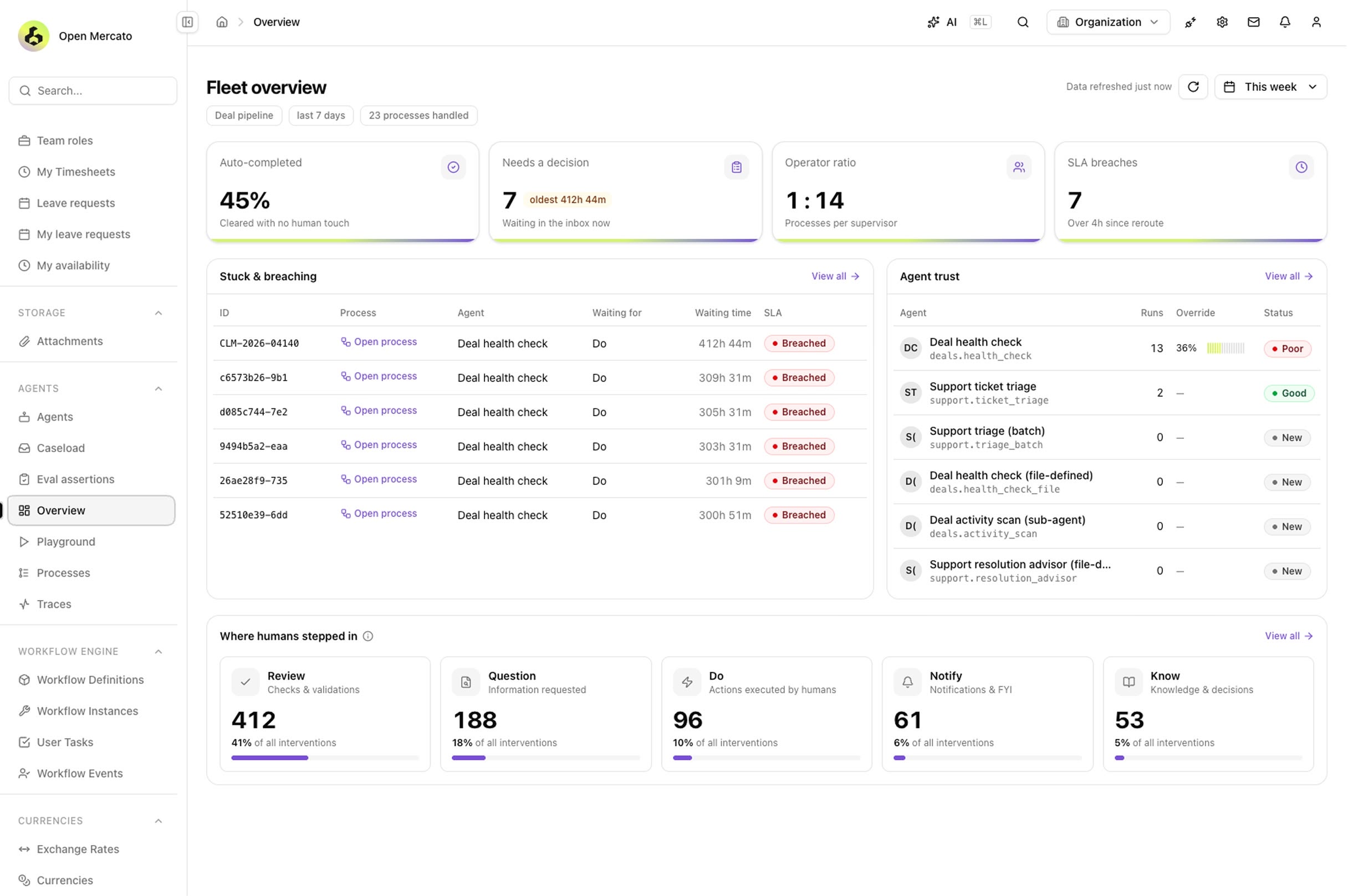
Run your agent where you already run
No walled garden. Pick the runtime that fits your stack. Your agent, your environment. We adapt to it — not the other way around.
OpenCode
Runs inside your Open Mercato Docker container.
In-process
Lightweight agents, no extra infrastructure.
Cloud runtimes
Azure AI Foundry, Google, Amazon and others via one connector.
An agent becomes a function in your workflow
The Agent Orchestrator plugs into Open Mercato Workflows through a new node — Invoke Agent. No glue code, no separate integration project.
Pass context
The workflow hands the agent a well-defined context.
It does the work
The agent runs as any other function.
Workflow waits
It resumes on the agent's response.
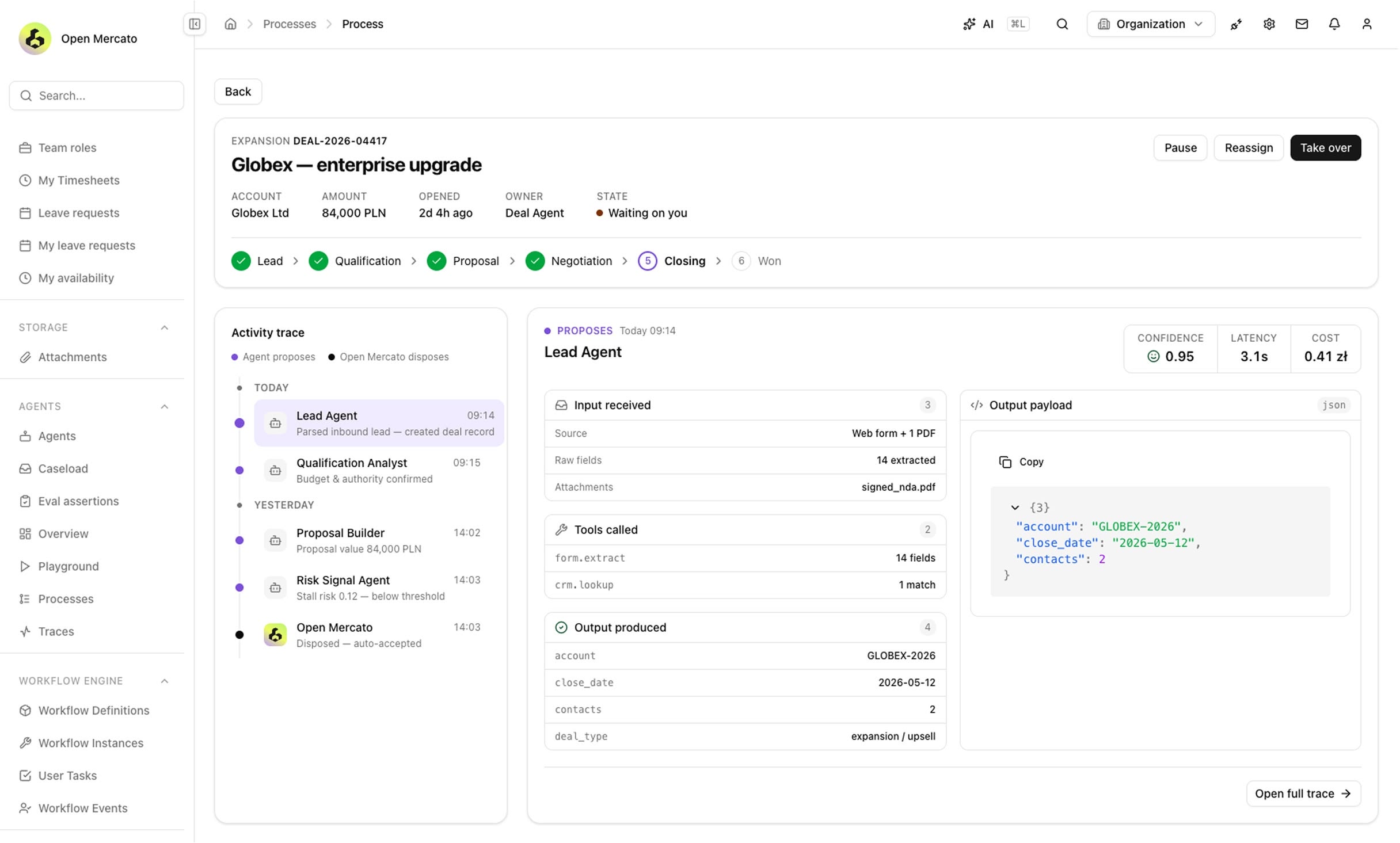
Two controls make it production-grade
Confidence thresholds
Set the bar. Above your threshold the agent decides and the workflow moves on. Below it, the decision escalates to a person. You decide how much autonomy you hand over.
Human-in-the-loop
When output needs sign-off, the workflow stops and routes it to the right person. The agent proposes, the human disposes.
Runs on top of the Open Mercato MCP Server — the tools you already expose are discoverable and callable by agents. No new tooling to wire up.
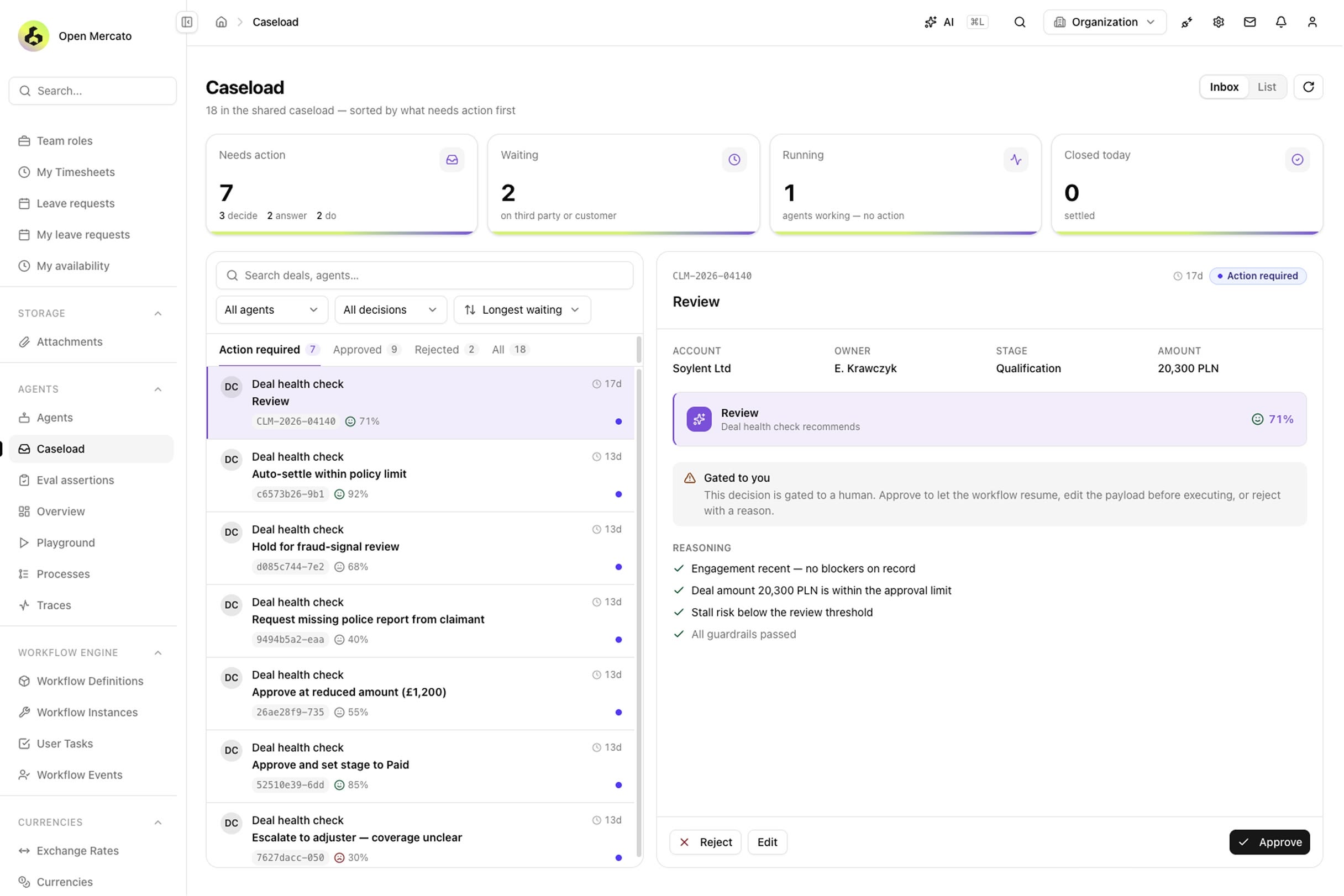
Trust, because you can see everything
Most platforms ask you to take their word for it. We log instead. Every agent action is audited exactly like a human action — a data change by an agent is traced the same way as one made by a person. Nothing off the record.
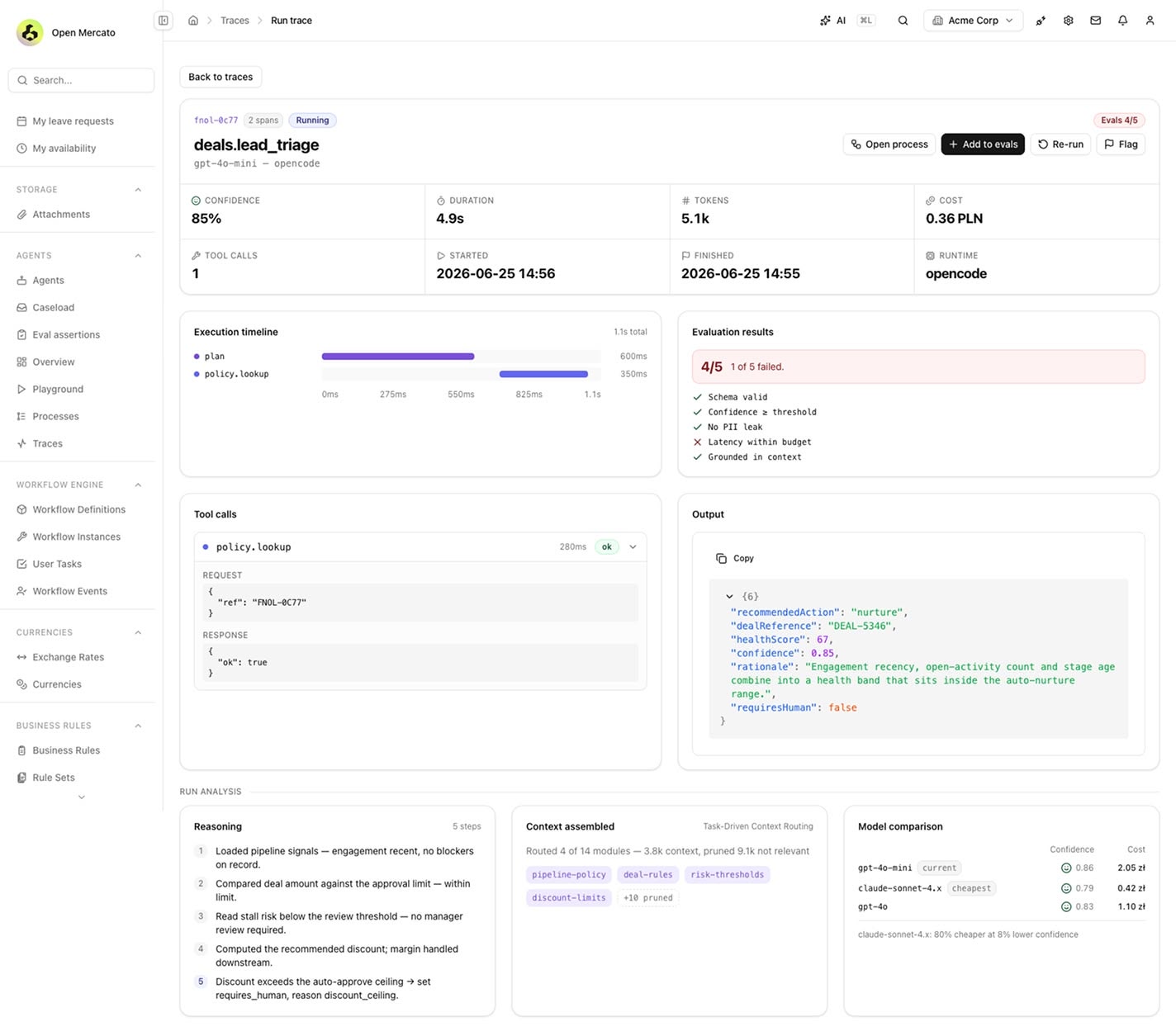
You always know what the agent did — and who put it to work. For regulated buyers, that's the price of entry.
Stop guessing whether your agent is any good
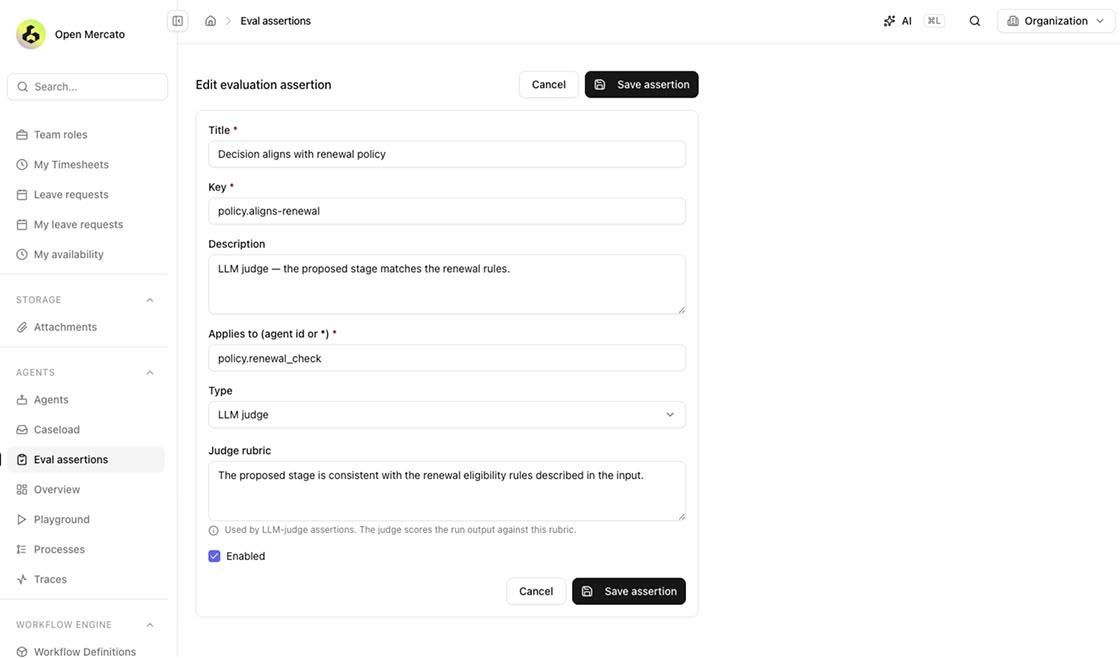
Agent Evals
You don't ship code without tests. Define evaluation scenarios, benchmark your agents against them, and watch how they hold up on real cases — in the same place they run.
Observability
See which model an agent used, what it cost in tokens, and how it performs over time. Admins and AgentOps teams tune behavior with real numbers.

How is this different from n8n?
Fair question — people ask it first.
The difference between automating a step and trusting an actor.
One layer, not three features
Runtimes, workflow integration, audit, evals — not four separate things. One coherent layer, start to finish.
Create
Define an agent, its tools and the runtime it runs on.
Run
As a standalone function or as a step inside a workflow.
Trace
Every action audited, two layers deep — agent and person.
Understand
Model, token cost and performance, all in one place.
Benchmark
Run evals against real-world scenarios.
AI agents spent two years doing impressive demos. This is the boring, hard part nobody screenshots — getting them safely into production.