 DocsTopicsSearch docsAPI referenceDocsTopicsSearch docsAPI reference
Framework
Implement a Tasks API that a client can create, read and update through HTTP. Start with the record and allowed inputs, then connect validation, commands and route metadata so the generated API description matches the behavior clients receive.
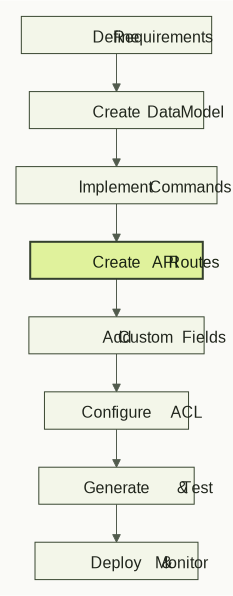
graph TD
    A[Define Requirements] --> B[Create Data Model]
    B --> C[Implement Commands]
    C --> D[Create API Routes]
    D --> E[Add Custom Fields]
    E --> F[Configure ACL]
    F --> G[Generate & Test]
    G --> H[Deploy & Monitor]


    classDef focus fill:#e0f29c,stroke:#34402d,color:#172011,stroke-width:2px
    class D focus
Start by understanding what you're building:
// Example: Task Management Module
interface Task {
  id: string;
  title: string;
  description?: string;
  status: "todo" | "in_progress" | "done";
  priority: "low" | "medium" | "high";
  assigneeId?: string;
  dueDate?: Date;
  tags: string[];
  // Custom fields: budget, complexity, etc.
}
Key Decisions:
import {
  Entity,
  Property,
  ManyToOne,
  Collection,
  OneToMany,
} from "@mikro-orm/postgresql";
import { UserEntity } from "../../../auth/data/entities";

@Entity({ tableName: "tasks" })
export class TaskEntity {
  @Property({ primary: true })
  id: string;

  @Property()
  title: string;

  @Property({ nullable: true })
  description?: string;

  @Property()
  status: string;

  @Property()
  priority: string;

  @Property({ nullable: true })
  assigneeId?: string;

  @ManyToOne(() => UserEntity, { nullable: true })
  assignee?: UserEntity;

  @Property({ nullable: true })
  dueDate?: Date;

  @Property()
  organizationId: string;

  @Property()
  tenantId: string;

  @Property()
  createdAt: Date;

  @Property({ nullable: true })
  updatedAt?: Date;

  @Property({ nullable: true })
  deletedAt?: Date;

  // Relations
  @OneToMany(() => TaskCommentEntity, (comment) => comment.task)
  comments = new Collection<TaskCommentEntity>(this);

  @OneToMany(() => TaskTagAssignmentEntity, (assignment) => assignment.task)
  tagAssignments = new Collection<TaskTagAssignmentEntity>(this);
}

@Entity({ tableName: "task_comments" })
export class TaskCommentEntity {
  @Property({ primary: true })
  id: string;

  @ManyToOne(() => TaskEntity)
  task!: TaskEntity;

  @Property()
  body: string;

  @Property({ nullable: true })
  authorId?: string;

  @Property()
  organizationId: string;

  @Property()
  tenantId: string;

  @Property()
  createdAt: Date;
}

@Entity({ tableName: "task_tag_assignments" })
export class TaskTagAssignmentEntity {
  @Property({ primary: true })
  id: string;

  @ManyToOne(() => TaskEntity)
  task!: TaskEntity;

  @Property()
  tagId: string;

  @Property()
  organizationId: string;

  @Property()
  tenantId: string;
}
import { z } from "zod";

// Base schemas
export const taskStatusSchema = z.enum(["todo", "in_progress", "done"]);
export const taskPrioritySchema = z.enum(["low", "medium", "high"]);

// Create schema
export const taskCreateSchema = z.object({
  title: z.string().min(1).max(255),
  description: z.string().optional(),
  status: taskStatusSchema.default("todo"),
  priority: taskPrioritySchema.default("medium"),
  assigneeId: z.string().uuid().optional(),
  dueDate: z.string().datetime().optional(),
  tags: z.array(z.string().uuid()).default([]),
  organizationId: z.string().uuid(),
  tenantId: z.string().uuid(),
});

// Update schema (partial)
export const taskUpdateSchema = taskCreateSchema
  .omit({ organizationId: true, tenantId: true })
  .partial()
  .extend({
    id: z.string().uuid(),
  });

// Comment schemas
export const commentCreateSchema = z.object({
  taskId: z.string().uuid(),
  body: z.string().min(1),
  organizationId: z.string().uuid(),
  tenantId: z.string().uuid(),
});
import { registerCommand } from "@open-mercato/shared/lib/commands";
import type { CommandHandler } from "@open-mercato/shared/lib/commands";
import {
  parseWithCustomFields,
  emitCrudSideEffects,
  setCustomFieldsIfAny,
} from "@open-mercato/shared/lib/commands/helpers";
import { CrudHttpError } from "@open-mercato/shared/lib/crud/errors";
import { resolveTranslations } from "@open-mercato/shared/lib/i18n/server";
import { TaskEntity, TaskTagAssignmentEntity } from "../data/entities";
import { taskCreateSchema, taskUpdateSchema } from "../data/validators";
import {
  ensureOrganizationScope,
  ensureTenantScope,
  syncEntityTags,
} from "./shared";
import { E } from "@open-mercato/core/generated/entities.ids.generated";

type TaskCreateInput = z.infer<typeof taskCreateSchema>;
type TaskUpdateInput = z.infer<typeof taskUpdateSchema>;

const createTaskCommand: CommandHandler<TaskCreateInput, { taskId: string }> = {
  id: "tasks.tasks.create",
  async execute(rawInput, ctx) {
    const { parsed, custom } = parseWithCustomFields(
      taskCreateSchema,
      rawInput
    );
    ensureTenantScope(ctx, parsed.tenantId);
    ensureOrganizationScope(ctx, parsed.organizationId);

    const em = ctx.container.resolve("em").fork();

    const task = em.create(TaskEntity, {
      id: crypto.randomUUID(),
      title: parsed.title,
      description: parsed.description,
      status: parsed.status,
      priority: parsed.priority,
      assigneeId: parsed.assigneeId,
      dueDate: parsed.dueDate ? new Date(parsed.dueDate) : undefined,
      organizationId: parsed.organizationId,
      tenantId: parsed.tenantId,
      createdAt: new Date(),
    });

    em.persist(task);

    // Handle tags
    await syncEntityTags(em, task, parsed.tags);

    await em.flush();

    // Set custom fields
    if (Object.keys(custom).length > 0) {
      const de = ctx.container.resolve("dataEngine");
      await setCustomFieldsIfAny({
        dataEngine: de,
        entityId: E.tasks.task_entity,
        recordId: task.id,
        organizationId: parsed.organizationId,
        tenantId: parsed.tenantId,
        values: custom,
        notify: true,
      });
    }

    // Emit events and update search index
    await emitCrudSideEffects({
      dataEngine: ctx.container.resolve("dataEngine"),
      action: "created",
      entity: task,
      identifiers: {
        id: task.id,
        organizationId: parsed.organizationId,
        tenantId: parsed.tenantId,
      },
      indexer: { entityType: E.tasks.task_entity },
    });

    return { taskId: task.id };
  },

  captureAfter: async (input, result, ctx) => {
    // Return snapshot for undo support
    const em = ctx.container.resolve("em");
    const task = await em.findOne(TaskEntity, { id: result.taskId });
    return task ? { task } : {};
  },

  buildLog: async ({ result, ctx }) => {
    const { translate } = await resolveTranslations();
    return {
      actionLabel: translate("tasks.audit.create", "Create task"),
      resourceKind: "tasks.task",
      resourceId: result.taskId,
      tenantId: ctx.auth?.tenantId,
      organizationId: ctx.selectedOrganizationId,
      payload: { result },
    };
  },

  undo: async ({ logEntry, ctx }) => {
    const taskId = logEntry.resourceId;
    if (!taskId) return;

    const em = ctx.container.resolve("em").fork();
    const task = await em.findOne(TaskEntity, { id: taskId });
    if (task) {
      await em.remove(task).flush();
    }
  },
};
const updateTaskCommand: CommandHandler<TaskUpdateInput, { taskId: string }> = {
  id: "tasks.tasks.update",
  async prepare(rawInput, ctx) {
    const { parsed } = parseWithCustomFields(taskUpdateSchema, rawInput);
    const em = ctx.container.resolve("em");
    const task = await em.findOne(TaskEntity, { id: parsed.id });
    return task ? { before: { task } } : {};
  },

  async execute(rawInput, ctx) {
    const { parsed, custom } = parseWithCustomFields(
      taskUpdateSchema,
      rawInput
    );
    const em = ctx.container.resolve("em").fork();

    const task = await em.findOne(TaskEntity, {
      id: parsed.id,
      deletedAt: null,
    });
    if (!task) {
      throw new CrudHttpError(404, { error: "Task not found" });
    }

    ensureTenantScope(ctx, task.tenantId);
    ensureOrganizationScope(ctx, task.organizationId);

    // Update fields
    if (parsed.title !== undefined) task.title = parsed.title;
    if (parsed.description !== undefined) task.description = parsed.description;
    if (parsed.status !== undefined) task.status = parsed.status;
    if (parsed.priority !== undefined) task.priority = parsed.priority;
    if (parsed.assigneeId !== undefined) task.assigneeId = parsed.assigneeId;
    if (parsed.dueDate !== undefined) {
      task.dueDate = parsed.dueDate ? new Date(parsed.dueDate) : undefined;
    }
    task.updatedAt = new Date();

    // Handle tags
    if (parsed.tags !== undefined) {
      await syncEntityTags(em, task, parsed.tags);
    }

    await em.flush();

    // Update custom fields
    if (custom && Object.keys(custom).length > 0) {
      const de = ctx.container.resolve("dataEngine");
      await setCustomFieldsIfAny({
        dataEngine: de,
        entityId: E.tasks.task_entity,
        recordId: task.id,
        organizationId: task.organizationId,
        tenantId: task.tenantId,
        values: custom,
        notify: true,
      });
    }

    await emitCrudSideEffects({
      dataEngine: ctx.container.resolve("dataEngine"),
      action: "updated",
      entity: task,
      identifiers: {
        id: task.id,
        organizationId: task.organizationId,
        tenantId: task.tenantId,
      },
      indexer: { entityType: E.tasks.task_entity },
    });

    return { taskId: task.id };
  },

  buildLog: async ({ ctx, snapshots }) => {
    const { translate } = await resolveTranslations();
    const before = snapshots.before?.task;
    if (!before) return null;

    const em = ctx.container.resolve("em");
    const after = await em.findOne(TaskEntity, { id: before.id });

    return {
      actionLabel: translate("tasks.audit.update", "Update task"),
      resourceKind: "tasks.task",
      resourceId: before.id,
      tenantId: before.tenantId,
      organizationId: before.organizationId,
      snapshotBefore: { task: before },
      snapshotAfter: after ? { task: after } : null,
      changes: buildChanges(before, after, ["title", "status", "priority"]),
    };
  },
};
Command files under commands/ are auto-discovered by yarn generate. The generated command-loader registry imports the matching command file on first use, so module index.ts should not import commands just for registration side effects.
import { z } from "zod";
import { makeCrudRoute } from "@open-mercato/shared/lib/crud/factory";
import { TaskEntity } from "../../data/entities";
import { E } from "@open-mercato/core/generated/entities.ids.generated";
import {
  buildCustomFieldFiltersFromQuery,
  extractAllCustomFieldEntries,
  splitCustomFieldPayload,
} from "@open-mercato/shared/lib/crud/custom-fields";
import { resolveTranslations } from "@open-mercato/shared/lib/i18n/server";
import { withScopedPayload } from "../utils";
import {
  createTasksCrudOpenApi,
  createPagedListResponseSchema,
  defaultOkResponseSchema,
} from "../openapi";

const listSchema = z
  .object({
    page: z.coerce.number().min(1).default(1),
    pageSize: z.coerce.number().min(1).max(100).default(50),
    search: z.string().optional(),
    status: z.string().optional(),
    priority: z.string().optional(),
    assigneeId: z.string().uuid().optional(),
    dueBefore: z.string().optional(),
    dueAfter: z.string().optional(),
    tags: z.string().optional(),
    sortField: z.string().optional(),
    sortDir: z.enum(["asc", "desc"]).optional(),
  })
  .passthrough();

const routeMetadata = {
  GET: { requireAuth: true, requireFeatures: ["tasks.tasks.view"] },
  POST: { requireAuth: true, requireFeatures: ["tasks.tasks.create"] },
  PUT: { requireAuth: true, requireFeatures: ["tasks.tasks.edit"] },
  DELETE: { requireAuth: true, requireFeatures: ["tasks.tasks.delete"] },
};

export const metadata = routeMetadata;

const crud = makeCrudRoute({
  metadata: routeMetadata,
  orm: {
    entity: TaskEntity,
    idField: "id",
    orgField: "organizationId",
    tenantField: "tenantId",
    softDeleteField: "deletedAt",
  },
  list: {
    schema: listSchema,
    entityId: E.tasks.task_entity,
    fields: [
      "id",
      "title",
      "description",
      "status",
      "priority",
      "assignee_id",
      "due_date",
      "organization_id",
      "tenant_id",
      "created_at",
      "updated_at",
      "cf:budget",
      "cf:estimated_hours",
    ],
    sortFieldMap: {
      title: "title",
      status: "status",
      priority: "priority",
      dueDate: "due_date",
      createdAt: "created_at",
    },
    buildFilters: async (query, ctx) => {
      const filters: Record<string, any> = {};

      if (query.search) {
        filters.title = { $ilike: `%${query.search}%` };
      }

      if (query.status) {
        filters.status = { $eq: query.status };
      }

      if (query.priority) {
        filters.priority = { $eq: query.priority };
      }

      if (query.assigneeId) {
        filters.assignee_id = { $eq: query.assigneeId };
      }

      // Date range filters
      if (query.dueBefore || query.dueAfter) {
        const range: any = {};
        if (query.dueAfter) range.$gte = new Date(query.dueAfter);
        if (query.dueBefore) range.$lte = new Date(query.dueBefore);
        filters.due_date = range;
      }

      // Tag filtering
      if (query.tags) {
        const tagIds = query.tags.split(",").filter(Boolean);
        if (tagIds.length > 0) {
          filters["tag_assignments.tag_id"] = { $in: tagIds };
        }
      }

      // Custom field filters
      if (ctx) {
        const cfFilters = await buildCustomFieldFiltersFromQuery({
          entityIds: [E.tasks.task_entity],
          query,
          em: ctx.container.resolve("em"),
          tenantId: ctx.auth?.tenantId ?? null,
        });
        Object.assign(filters, cfFilters);
      }

      return filters;
    },
    joins: [
      {
        alias: "tag_assignments",
        table: "task_tag_assignments",
        from: { field: "id" },
        to: { field: "task_id" },
        type: "left",
      },
    ],
    transformItem: (item) => {
      if (!item) return item;
      const cfEntries = extractAllCustomFieldEntries(item);
      return { ...item, ...cfEntries };
    },
    export: {
      enabled: true,
      formats: ["csv", "json"],
      filename: "tasks_export",
      columns: [
        { field: "id", header: "ID" },
        { field: "title", header: "Title" },
        { field: "status", header: "Status" },
        { field: "priority", header: "Priority" },
        { field: "due_date", header: "Due Date" },
        { field: "cf:budget", header: "Budget" },
      ],
    },
  },
  actions: {
    create: {
      commandId: "tasks.tasks.create",
      schema: z.object({}).passthrough(),
      mapInput: async ({ raw, ctx }) => {
        const { translate } = await resolveTranslations();
        const scoped = withScopedPayload(raw, ctx, translate);
        const { base, custom } = splitCustomFieldPayload(scoped);
        return Object.keys(custom).length
          ? { ...base, customFields: custom }
          : base;
      },
      response: ({ result }) => ({ id: result?.taskId }),
      status: 201,
    },
    update: {
      commandId: "tasks.tasks.update",
      schema: z.object({ id: z.string().uuid() }).passthrough(),
      mapInput: async ({ raw, ctx }) => {
        const { translate } = await resolveTranslations();
        const scoped = withScopedPayload(raw, ctx, translate);
        const { base, custom } = splitCustomFieldPayload(scoped);
        return Object.keys(custom).length
          ? { ...base, customFields: custom }
          : base;
      },
      response: () => ({ ok: true }),
    },
    delete: {
      commandId: "tasks.tasks.delete",
      mapInput: ({ parsed }) => ({ id: parsed.id }),
      response: () => ({ ok: true }),
    },
  },
});

export const { GET, POST, PUT, DELETE } = crud;
Note · Who maintains the query index on the actions.* path
A verb configured through actions.* executes via the command bus, which flushes the CRUD
side effects the command handler queued – the route never marks the record itself. The
route's own indexer: declaration is still honoured: it is handed to the data engine for
the duration of that command and applied to a handler mark that carries no indexer of its
own, so a handler ending in emitCrudSideEffects({ ..., events }) indexes the record under
the route's entityType. A handler that passes its own indexer: keeps it, and the
declaration only ever applies to marks for the route's own orm.entity class, so a handler
that also marks a related entity is unaffected.
A handler that queues no side effect at all indexes nothing – there is no mark to complete. That case is logged as a warning naming the route, verb and command id, so a projection that silently stops updating is diagnosable instead of invisible.
import { z } from "zod";
import type { ZodTypeAny } from "zod";
import type { OpenApiRouteDoc } from "@open-mercato/shared/lib/openapi";
import {
  createCrudOpenApiFactory,
  createPagedListResponseSchema as createSharedPagedListResponseSchema,
  defaultCreateResponseSchema as sharedDefaultCreateResponseSchema,
  defaultOkResponseSchema as sharedDefaultOkResponseSchema,
} from "@open-mercato/shared/lib/openapi/crud";

export const defaultCreateResponseSchema = sharedDefaultCreateResponseSchema;
export const defaultOkResponseSchema = sharedDefaultOkResponseSchema;

export function createPagedListResponseSchema(itemSchema: ZodTypeAny) {
  return createSharedPagedListResponseSchema(itemSchema, {
    paginationMetaOptional: true,
  });
}

const buildTasksCrudOpenApi = createCrudOpenApiFactory({
  defaultTag: "Tasks",
  defaultCreateResponseSchema,
  defaultOkResponseSchema,
  makeListDescription: ({ pluralLower }) =>
    `Returns a paginated collection of ${pluralLower} scoped to the authenticated organization.`,
});

export function createTasksCrudOpenApi(options: any): OpenApiRouteDoc {
  return buildTasksCrudOpenApi(options);
}

const taskListItemSchema = z.object({
  id: z.string().uuid(),
  title: z.string(),
  description: z.string().nullable().optional(),
  status: z.string(),
  priority: z.string(),
  assignee_id: z.string().uuid().nullable().optional(),
  due_date: z.string().nullable().optional(),
  organization_id: z.string().uuid(),
  tenant_id: z.string().uuid(),
  created_at: z.string(),
  updated_at: z.string().nullable().optional(),
});

const taskCreateResponseSchema = z.object({
  id: z.string().uuid(),
});

// Export the OpenAPI spec for the main route
export const openApi = createTasksCrudOpenApi({
  resourceName: "Task",
  pluralName: "Tasks",
  querySchema: z.object({
    page: z.coerce.number().optional(),
    pageSize: z.coerce.number().optional(),
    search: z.string().optional(),
    status: z.string().optional(),
    priority: z.string().optional(),
    assigneeId: z.string().uuid().optional(),
    dueBefore: z.string().optional(),
    dueAfter: z.string().optional(),
    tags: z.string().optional(),
  }),
  listResponseSchema: createPagedListResponseSchema(taskListItemSchema),
  create: {
    schema: z.object({
      title: z.string(),
      description: z.string().optional(),
      status: z.enum(["todo", "in_progress", "done"]).optional(),
      priority: z.enum(["low", "medium", "high"]).optional(),
      assigneeId: z.string().uuid().optional(),
      dueDate: z.string().datetime().optional(),
      tags: z.array(z.string().uuid()).optional(),
    }),
    responseSchema: taskCreateResponseSchema,
    description: "Creates a new task with optional custom fields.",
  },
  update: {
    schema: z.object({
      id: z.string().uuid(),
      title: z.string().optional(),
      description: z.string().optional(),
      status: z.enum(["todo", "in_progress", "done"]).optional(),
      priority: z.enum(["low", "medium", "high"]).optional(),
      assigneeId: z.string().uuid().optional(),
      dueDate: z.string().datetime().optional(),
      tags: z.array(z.string().uuid()).optional(),
    }),
    responseSchema: defaultOkResponseSchema,
    description: "Updates an existing task.",
  },
  del: {
    schema: z.object({ id: z.string().uuid() }),
    responseSchema: defaultOkResponseSchema,
    description: "Deletes a task by id.",
  },
});
import { E } from "@open-mercato/core/generated/entities.ids.generated";

export const entities = [
  {
    id: E.tasks.task_entity,
    name: "Task",
    fields: [
      {
        key: "budget",
        label: "Budget",
        kind: "currency",
        required: false,
        description: "Estimated budget for the task",
      },
      {
        key: "estimated_hours",
        label: "Estimated Hours",
        kind: "number",
        required: false,
        description: "Estimated hours to complete the task",
      },
      {
        key: "complexity",
        label: "Complexity",
        kind: "select",
        options: ["simple", "medium", "complex"],
        required: false,
        description: "Task complexity level",
      },
      {
        key: "external_id",
        label: "External ID",
        kind: "text",
        required: false,
        description: "ID from external system",
      },
    ],
  },
];
export const features = [
  "tasks.tasks.view",
  "tasks.tasks.create",
  "tasks.tasks.edit",
  "tasks.tasks.delete",
  "tasks.comments.view",
  "tasks.comments.create",
  "tasks.comments.edit",
  "tasks.comments.delete",
];
export const metadata = {
  name: "Tasks",
  description: "Task management and tracking",
  version: "1.0.0",
};
# Generate module registry and entity IDs
yarn generate
# Generate migrations for new entities
yarn db:generate

# Apply migrations
yarn db:migrate
import { describe, it, expect } from "vitest";
import { createTestContext } from "@open-mercato/shared/lib/test";
import { executeCommand } from "@open-mercato/shared/lib/commands";

describe("tasks API", () => {
  const ctx = createTestContext();

  it("creates a task", async () => {
    const { result } = await executeCommand(
      "tasks.tasks.create",
      {
        title: "Test Task",
        description: "A test task",
        status: "todo",
        priority: "medium",
        organizationId: ctx.organizationId,
        tenantId: ctx.tenantId,
      },
      ctx
    );

    expect(result.taskId).toBeDefined();
  });

  it("lists tasks with filtering", async () => {
    // Test the GET endpoint
    const response = await ctx.request(
      "/api/tasks/tasks?status=todo&pageSize=10"
    );
    expect(response.status).toBe(200);

    const data = await response.json();
    expect(Array.isArray(data.items)).toBe(true);
  });

  it("updates a task", async () => {
    const createResult = await executeCommand(
      "tasks.tasks.create",
      {
        title: "Task to Update",
        organizationId: ctx.organizationId,
        tenantId: ctx.tenantId,
      },
      ctx
    );

    const { result } = await executeCommand(
      "tasks.tasks.update",
      {
        id: createResult.result.taskId,
        status: "in_progress",
      },
      ctx
    );

    expect(result.taskId).toBe(createResult.result.taskId);
  });
});
# Run API tests
yarn test -- src/modules/tasks/api

# Test OpenAPI generation
yarn openapi:generate
# Build the application
yarn build

# Deploy to staging/production
# ... deployment commands ...
# Enable profiling
OM_PROFILE=tasks.* yarn dev

# Check for slow queries
# Monitor API response times
# Check error rates
// Use CrudHttpError for consistent error responses
throw new CrudHttpError(400, {
  error: "Invalid task status transition",
  details: { current: "done", requested: "todo" },
});
// Business rule validation in commands
if (input.status === "done" && !input.completedAt) {
  input.completedAt = new Date();
}
// Use efficient queries
list: {
  fields: ['id', 'title'], // Only select needed fields
  // Use appropriate indexes in database
}
// Always scope to organization/tenant
ensureOrganizationScope(ctx, entity.organizationId);
ensureTenantScope(ctx, entity.tenantId);
E.tasks.task_entity exists in generated filesce.ts exports entities correctlyopenApi constantyarn generate and verify command-loaders.generated.ts includes the command filetenantId and organizationId are provided# Enable detailed logging
DEBUG=crud:* yarn dev
# Check module registry
yarn generate --verbose
# Validate migrations
yarn db:migrate --dry-run
This workflow provides a complete guide to creating robust, scalable APIs in open-mercato with all the necessary components working together.