
The most dangerous competitor we meet in enterprise deals is not Salesforce. It is not SAP. It is your own engineering team with a Claude Code subscription ;-)
This summer we went through 50 transcripts of our own sales calls, across 17 enterprise accounts. Insurance, telco, brewing, construction, fintech, freight. One pattern kept repeating. The IT leader listens to the pitch, nods, and says: "we'll just write it ourselves."
And honestly? On the first part, they are right. That is what this article is about.
The weekend demo is real
A senior engineer with Claude Code will build a working CRM prototype over a weekend. I am not going to argue with that. It is how we work ourselves - at Open Mercato almost nobody writes code by hand. We merge 200-280 AI-generated pull requests every week, reviewed by humans, shipped by a community of 100+ contributors.
We have seen the pattern up close. In one fintech account, an engineer had a working prototype built with Claude Code before our second call. A telco told us their plan was to write the whole thing in-house. An insurer had its own GenAI team. A global brewer was building its own spec-driven framework.
So when an IT director says "my team can build this with Claude Code" - I agree. On the demo.
Then year two shows up
Here is what the same buyers say twenty minutes later in the same calls. An IT director at a retail group put it best: "success is not launching an MVP - it's running a stable platform."
Nobody in the enterprise is afraid of building anymore. They are afraid of year two. Who upgrades this? Who audits it? What happens when the engineer who prompted it into existence changes jobs?
The data says this fear is rational. Stack Overflow Developer Survey 2025 (49,000 respondents): 84% of developers use AI tools, 46% do not trust the output, 66% spend more time debugging "almost-correct" AI code than before.
An academic paper gave the problem a name - the Productivity-Reliability Paradox (arXiv:2605.01160, May 2026). The numbers: 98% more merged PRs, 91% longer review times, flat delivery metrics. Its conclusion is blunt:
"Specification discipline, not model capability, is the binding constraint on AI-assisted software dependability."
Claude Code is not your bottleneck. The missing foundation underneath it is.
What Claude Code decides - and what it doesn't
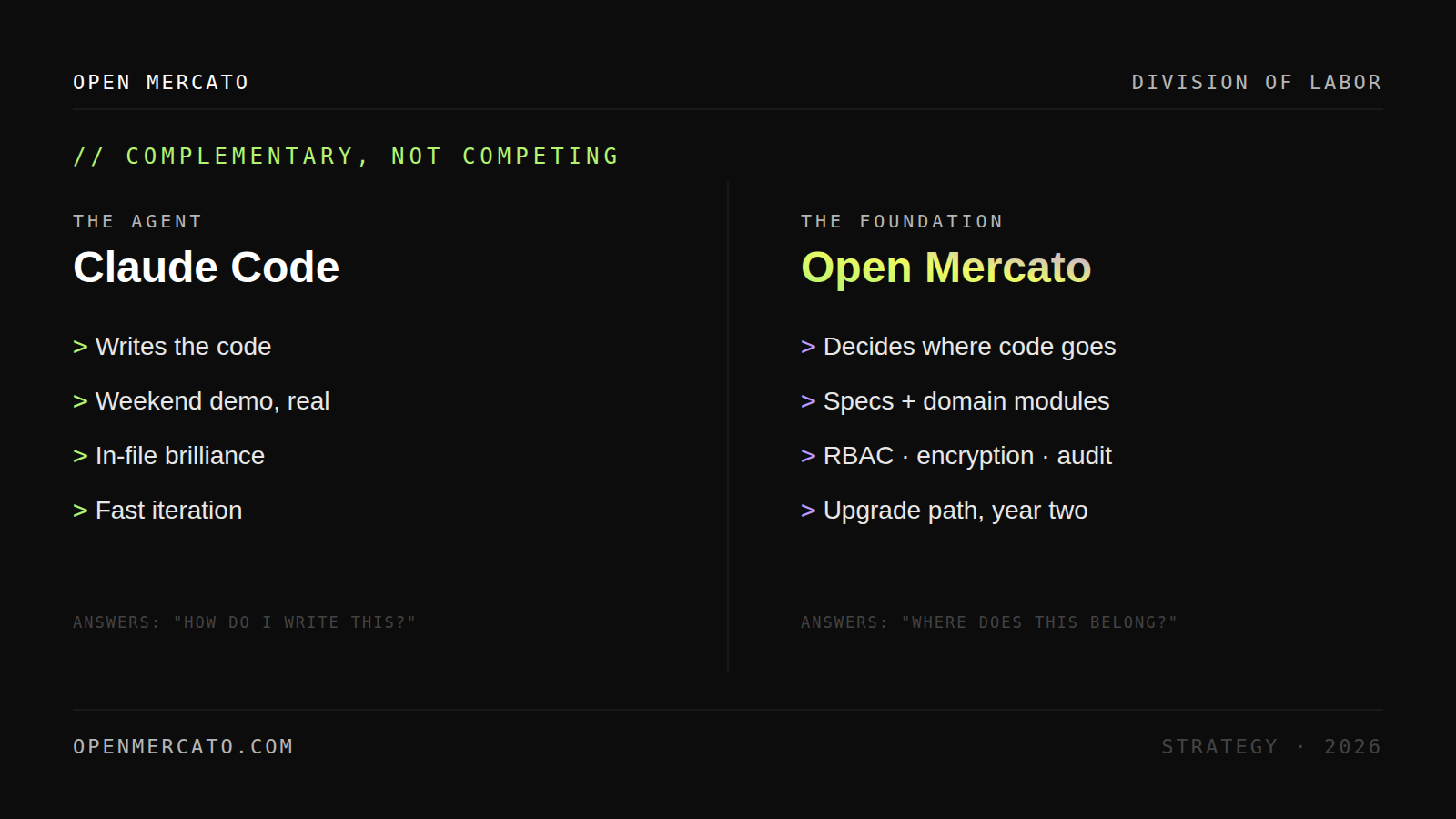
Claude Code answers "how do I write this code?" better than anything I have seen. It does not answer:
- Where does this code belong in a system that 30 engineers touch?
- Which patterns keep multi-tenancy, RBAC and audit trails consistent everywhere?
- What breaks in three other modules when this PR merges?
- How do we upgrade the core next year without a replatforming project?
These are architecture decisions. No agent makes them for you. And when every developer prompts differently, every developer invents a different architecture. That is exactly how you get twice the PRs and the same delivery.
Open Mercato is what Claude Code runs on
Open Mercato is not a competitor to Claude Code. It is the foundation the agent works on top of. Here is the division of labor:
- Specs ship in the repo. When Claude Code generates a feature, it reads the spec first. It knows where the code goes, which boundaries to respect, and what would break if ignored.
- Domain modules at 80% done. CRM/ERP entities, pricing, pipelines, multi-tenancy - already built. Agents extend instead of inventing.
- Guard-rails the agent cannot skip. Field-level encryption, RBAC per feature, full audit logs, a command pattern where ~99% of writes have an undo, reversible migrations.
- The harness. The same skills, prompts and tests we use to build Open Mercato itself ship to your team. Claude Code, Cursor and Codex all plug into it.
Same model, same agent, different outcome. Without the spec: code that compiles, passes local tests, and breaks three modules in production. With it: architecture-aware output from your whole team, not just your two best seniors. In our own work this cut "AI code that needs senior review" by roughly 60%.
The stack, as an IT leader should draw it
Four layers:
- Model - Claude, GPT, open weights. Swappable.
- Agent - Claude Code, Cursor, Codex. Generates the code.
- Foundation - architecture, specs, domain modules, governance. This is Open Mercato.
- Your business logic - the only layer your team should be writing.
Most companies made deliberate choices on layers one and two. Layer three is usually accidental - whatever each developer's context window contained that day. That accident is what you will be maintaining in year two.
When Claude Code alone is enough
Let me be honest, because we say this on sales calls too. If you are building an internal tool for one team, with no regulated data and a scope you could throw away - you do not need us. Claude Code and a clean repo will do the job.
You need a foundation when the system crosses teams, touches regulated data, has to live five-plus years, needs a real upgrade path, and will face an auditor asking who changed what and when.
One exercise for next week
Pull two numbers from last quarter: PRs merged and features shipped. If the first doubled and the second did not move, you do not have a model problem or a talent problem. You have a foundation problem.
Open Mercato is MIT-licensed and open source. Clone it, point your agent at it, build one process end to end.
Bring your Claude Code subscription. It will finally have something solid to stand on.
Sources: Stack Overflow Developer Survey 2025; Sabry E. Farrag, The Productivity-Reliability Paradox, arXiv:2605.01160 (May 2026).
Start with 80% done: openmercato.com