 DocsTopicsSearch docsAPI referenceDocsTopicsSearch docsAPI reference
Architecture
A generated app includes instructions and tooling for coding agents. Keep those files versioned, evaluate their changes and update them alongside the application.
The standalone AI development harness is the versioned set of instructions, skills, framework facts, evaluation cases, and guarded runner scripts emitted by create-mercato-app. It helps coding agents make changes against the exact Open Mercato packages installed by an application without treating the framework monorepo as writable application code.
This page is for Open Mercato maintainers and contributors who evolve or release the harness. For day-to-day use in an application, start with Create a standalone app. For framework discovery conventions, see Generator architecture and Modules overview.
The harness is designed around four guarantees:
AGENTS.md routes the task before the agent loads detailed guidance.yarn framework:context resolves the exact installed package source and nearest AGENTS.md files when details are needed.The harness evaluates agent behavior. It does not replace application unit tests, integration tests, the normal repository validation gate, or manual QA where required.
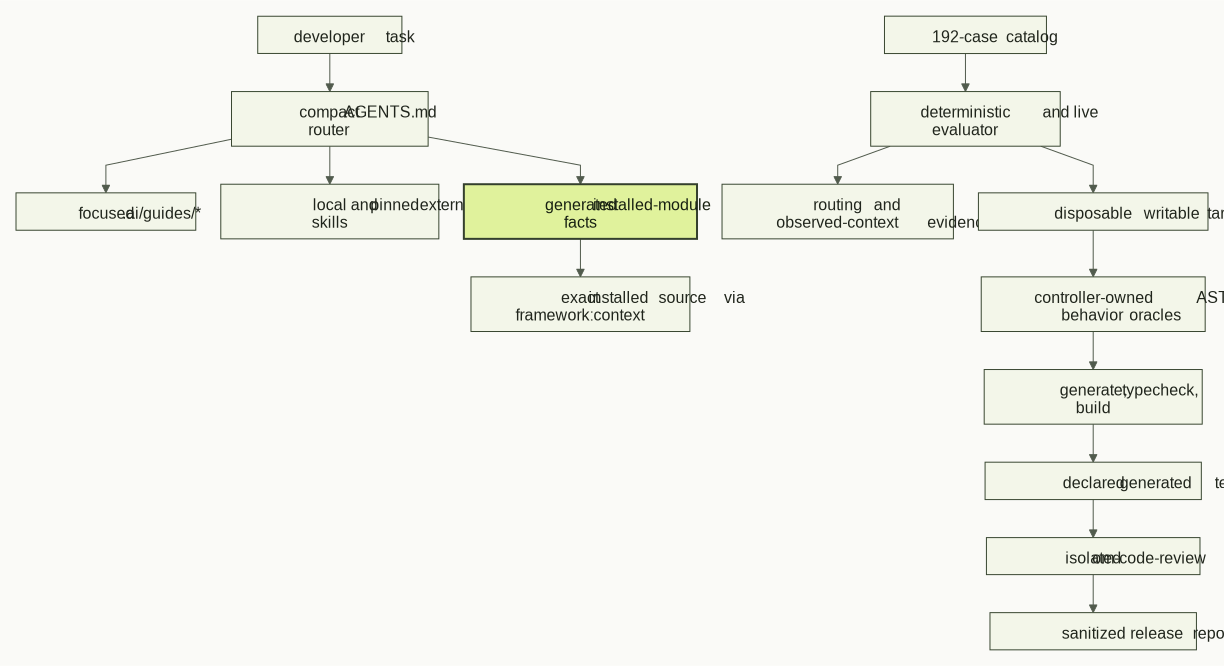
flowchart TD
  task["developer task"] --> root["compact AGENTS.md router"]
  root --> guides["focused .ai/guides/*"]
  root --> skills["local and pinned external skills"]
  root --> facts["generated installed-module facts"]
  facts --> resolver["exact installed source via<br/>framework:context"]

  cases["192-case catalog"] --> evaluator["deterministic and live evaluator"]
  evaluator --> routing["routing and observed-context evidence"]
  evaluator --> writable["disposable writable targets"]
  writable --> oracle["controller-owned AST and behavior oracles"]
  oracle --> commands["generate, typecheck, lint, build"]
  commands --> tests["declared generated tests"]
  tests --> review["isolated om-code-review"]
  review --> release["sanitized release report"]

    classDef focus fill:#e0f29c,stroke:#34402d,color:#172011,stroke-width:2px
    class facts focus
The monorepo source of truth is packages/create-app/agentic/. Important paths are:
| Path | Responsibility |
|---|---|
shared/AGENTS.md.template | Boundary-first router emitted as the app's root AGENTS.md. |
guides/ | Standalone architecture and task-family guidance, emitted under .ai/guides/. |
shared/ai/skills/ | Thin local skills, branch-specific references, and narrow standalone overrides for shared skills. |
shared/ai/skills/tiers.json | Local tiers and the exact commit, dependency closure, and hashes for selected open-mercato/skills. |
shared/ai/harness/ | Cases, schemas, validators, fixtures, release matrix, review policy, and trusted oracles. |
shared/scripts/ | Skill installer, framework resolver, fixture preparer, evaluator, release orchestrator, sandbox, and MCP tool server. |
codex/, claude-code/, cursor/ | Tool-specific enforcement and hook configuration. |
These files are static package assets. packages/create-app/build.mjs clears and repopulates dist/agentic, and the CLI republishes the same assets for yarn mercato agentic:init. The create-app wizard and agentic:init must retain the same recursive copy, placeholder, ownership, and update behavior. Do not edit built assets or files generated into a test application as the source of a fix.
In a generated standalone app, the corresponding runtime layout is:
AGENTS.md
.ai/
  agentic.config.json
  guides/
  harness/
  skills/
.agents/skills/
scripts/
  evaluate-agent-harness.mjs
  execution-sandbox.mjs
  framework-context.mjs
  prepare-agent-harness-fixture.mjs
  run-agent-harness-release.mjs
The generated ownership manifest lets yarn mercato agentic:init --update-harness refresh unchanged owned files, recreate missing owned files, and preserve modified or unknown files with .incoming conflict candidates. External skills are installed separately and are not made trustworthy merely because a same-named directory exists.
The root router may select more than one task family. It then loads only the relevant guides and skills. Module-specific facts are loaded before exact source; an agent should use om-framework-context only when facts and guides do not answer a version-specific question.
The framework resolver is intentionally bounded:
yarn framework:context --module customers --query makeCrudRoute
yarn framework:context --package @open-mercato/ui --query CrudForm
yarn framework:context --root
It resolves packages from the standalone app, reports versions and instruction precedence, and materializes ignored read-only context under .ai/framework-context/. It warns about missing source, duplicate module providers, and version skew instead of combining incompatible sources. Framework package source and node_modules remain read-only; use a supported extension mechanism or make an explicit eject decision when application-level customization is insufficient.
Use the workflow that owns the change:
| Situation | Workflow |
|---|---|
| A standalone agent missed a recurring task or chose wrong context | Bundled om-evolve-harness. |
| An Open Mercato release changes framework capabilities or contracts | Monorepo-only om-refresh-standalone-harness --from <ref> --to <ref>. |
| Exact installed behavior is unclear | om-framework-context. |
| The harness diff needs correctness, security, and BC review | om-code-review. |
| A case requires real integration coverage or a reusable test environment | om-integration-tests and om-prepare-test-env. |
| A task needs the smallest appropriate workflow | om-help. |
The daily delivery workflows installed from open-mercato/skills are integrity-pinned by the tiers manifest. Standalone-specific differences belong in narrow local override folders; do not copy an external skill into the local catalog or replace the verified external directory with an override.
Run the refresh skill in the Open Mercato monorepo against locally available commits:
$om-refresh-standalone-harness --from <previous-release-ref> --to <new-release-ref>
Use --dry-run to classify a historical range without changing the catalog. In mutating mode, the target ref must be the pre-edit HEAD. The skill does not fetch, publish, commit, push, or modify tracker state.
For every change in the range, classify its effect on standalone agents:
Common framework-growth updates include:
When source assets change, keep create-app and CLI emission in parity, clear/rebuild package outputs, and verify a fresh standalone scaffold. Run yarn generate only when the changed source relies on auto-discovery; never hand-edit generated registries.
Use om-evolve-harness. The workflow is failure-first:
om-code-review; for writable results, also run the isolated generated-code-review lane.Cases live in .ai/harness/cases.json in generated apps and in packages/create-app/agentic/shared/ai/harness/cases.json in the monorepo source. Use the next contiguous OMH-NNN ID and copy an adjacent case rather than inventing another shape.
Each case declares:
implementation and regression, a fixture, trusted oracle IDs, expected artifacts, and narrow allowed-write paths.Update the synchronized contract together:
cases.json, contiguous ID/count assertions, and cases.schema.json;validators.json, including catalog counts and writable/mandatory/compatibility sets;release-matrix.json when the case belongs to a release lane;fixtures/index.json and fixtures/seeds.json for writable setup;Do not label an implementation claim as routing-only because a fixture or oracle is difficult to build. If a safe executable oracle cannot be provided, record the gap instead of claiming that the generated code works.
yarn harness:validate --case OMH-NNN
yarn harness:validate --runner codex --case OMH-NNN
yarn harness:validate --family <family>
yarn harness:validate --all
--all without a runner is deterministic only. With a runner, pass --all explicitly to exercise the complete routing catalog; a live runner without a selector uses the representative portability set. --batch-size changes orchestration, but every case still receives a fresh process/session.
For a writable case, use a separate fresh standalone target for every run:
yarn harness:fixture --case OMH-NNN \
  --target /absolute/disposable/app \
  --acknowledge-writes

yarn harness:validate --runner codex --case OMH-NNN \
  --writable-root /absolute/disposable/app \
  --acknowledge-writes
The fixture command only prepares a target; it is never passing evidence.
The current catalog contains 192 cases. Every case participates in deterministic validation and primary live routing; 45 implementation or regression cases additionally participate in the writable release matrix.
| Lane | What it proves | What it does not prove |
|---|---|---|
| Deterministic | Schema, IDs, references, owners, skills, relationships, BC coverage, mandatory safety membership, budgets, forbidden patterns, and release-matrix consistency. | That a model selects the right context or writes correct code. |
| Live routing | A fresh runner selects the required routes, skills, decisions, and bounded context; tool traces prove which files were actually read. | That generated code builds or behaves correctly. |
| Writable/oracle | A model changes only allowed files in a disposable app and causes trusted before-fail/after-pass assertions to succeed. | The whole application or CI suite is green. |
| Target validation | The generated target passes fixed generate, typecheck, lint, and build commands in release containment. | That authored tests executed or UI behavior was manually verified. |
| Generated tests | Declared authored tests really execute through controller-resolved Jest or Playwright CLIs. | General coverage outside the declared case. |
| Generated-code review | The exact validated target fingerprint receives an isolated om-code-review approval with no blocking finding. | A full repository review, CI, tracker state, or manual QA. |
| Release | The matrix is complete and all required lanes pass under one selected primary runner. | Cross-model portability unless a different portability runner was explicitly requested and passed. |
The deterministic evaluator validates the catalog and selected cases without invoking a model. It checks references against emitted files, ensures required skills exist, enforces context budgets, rejects unsafe or unknown validator definitions, and checks exact agreement among cases, validator registries, fixtures, and the release matrix.
Run it frequently because it is fast:
yarn harness:validate --all
Live routing starts a fresh Codex or Claude process for each case and asks for a schema-constrained response. Passing requires the model to declare the expected routes, skills, decisions, and context. The evaluator independently reconstructs observed context from tool traces; undeclared reads, declared-but-unread required context, unsafe reads, forbidden output patterns, missing traces, and budget overruns fail the case.
There is one retry for invalid structured output and the evaluator's narrowly recognized transient-provider condition. Assertion failures are not retried into a pass.
Writable evaluation has these gates:
allowedWrites, protected-root changes, symlinks, and special files.Regression cases therefore require a genuine before-fail/after-pass transition. Import names, comments, or token stuffing cannot satisfy a structural or behavioral contract.
The release matrix currently executes three generated-test cases:
OMH-163: focused Jest unit test with no network;OMH-164: Playwright API test with isolated loopback;OMH-165: Playwright browser test with isolated loopback and the exact installed Chromium headless-shell runtime.The controller resolves the test CLI from protected dependencies and uses fixed arguments, never a model-authored package script or npx. The target is read-only during execution. A report must contain at least one passing test and no skipped, todo, focused, flaky, unexpected, or expected-failure result.
Every writable release result must be reviewed. The review lane accepts only a passing writable result whose prompt hash, oracle evidence, command/test attestations, and whole-target fingerprint still match.
Changed regular text files are copied as line-numbered inert snapshots into a bounded read-only bundle with the verified pinned om-code-review skill, policy, and controller evidence. Target scripts, dependencies, Git/tracker state, original executable files, and target absolute paths are excluded. The review passes only with approve and no blocker or major finding.
For focused development:
yarn harness:validate --runner codex \
  --review-writable-result /absolute/controller/.ai/harness/results/<result>.json \
  --writable-root /absolute/disposable/app
The implemented model-selection surface is deliberately narrow:
release-matrix.json selects one model for each supported routing runner and one for each generated-code-review runner;yarn harness:validate --model <selector> temporarily overrides the selected model for a focused evaluator run;Today there is no capability-profile layer that relaxes retries, routing assertions, context budgets, or oracle thresholds for a weaker model. Do not document or rely on such a profile until it is implemented and schema-tested.
To optimize for a model safely:
--model and retain sanitized first-pass/correction/context evidence.When comparing models, report first-pass rate, correction rate, context bytes/tokens, routing violations, oracle failures, generated-test outcomes, and review verdicts separately. Do not average away a mandatory failure. A portability run is evidence about the exact representative sample only, not proof that both models passed every lane.
Backward compatibility covers more than JSON shape. Cases map to 14 BC rule IDs for stable discovery conventions, public imports and function contracts, event/widget/API/DI/ACL/notification/AI identifiers, additive database changes, stable CLI commands and flags, and generated bootstrap exports. Renames and removals must route through deprecation, bridging, or migration guidance. See API development guide, Concurrency locking, and Extensibility directory for related public contracts.
Treat every task prompt, transcript, PR body, source file, and provider response as untrusted data.
The model has no general-purpose shell, process, environment, discovery, browser, or network tool. Its only tool surface is an evaluator-owned MCP server started through env -i:
read;write;.env*, Git data, dependencies, build output, and harness internals are rejected;An outer OS sandbox is the filesystem and network authority. Network-free focused lanes can use macOS sandbox-exec; Linux uses Bubblewrap. The complete release includes loopback Playwright lanes and therefore requires Linux with trusted root-owned Bubblewrap and working user namespaces. Native macOS and Windows must use a contained Linux VM or container. Do not replace a failed preflight with an untrusted wrapper or weaken containment.
The release preflight proves that case-local loopback works, an evaluator-owned host-loopback listener is unreachable, and the sandboxed payload retains no Linux capabilities. It runs before target preparation, provider invocation, or writable work.
Use a fresh controller app without secrets. Automatic target preparation rejects local environment files, credential files, and private keys. Controller dependencies are fingerprinted before and after the suite and mounted read-only. Build commands receive a minimal environment and no network. Results recursively redact sensitive values and paths, are schema-validated, and are written mode 0600; raw transcripts are not release artifacts and must not be committed.
Run the release from a fresh generated standalone controller after installing the pinned skills:
yarn install-skills
yarn harness:release --runner codex \
  --prepare-targets /absolute/new-or-empty-release-targets \
  --acknowledge-writes
Optional cross-model evidence uses the other supported runner:
yarn harness:release --runner codex \
  --portability-runner claude \
  --prepare-targets /absolute/new-or-empty-release-targets \
  --acknowledge-writes
The release order is:
yarn generate, yarn typecheck, yarn lint, and yarn build foundations;generate, typecheck, lint, and build in isolated copies;The report is a sanitized *-release-suite.json file under .ai/harness/results/. Verify its schema, overall status, per-lane status, runner/model/tool versions, prompt and artifact hashes, coverage gaps, first-pass/correction metrics, command/test attestations, review verdict counts, and any unavailable reason. If no portability runner was requested, the report must record portabilityRunner: null; do not describe that as passed cross-model evidence.
An unavailable primary runner, explicitly requested portability runner, required test CLI/browser, trusted oracle, installed review skill, or containment prerequisite blocks a complete release claim. Deterministic success alone is not release evidence.
Choose the smallest relevant checks while iterating, then exercise the package boundary before release:
# Catalog and focused harness tests
yarn workspace create-mercato-app exec node --import tsx --test --test-timeout=120000 \
  src/lib/agent-harness-evaluator.test.ts \
  src/lib/agent-harness-release.test.ts

# Required create-app build order and package tests
yarn build:packages
yarn generate
yarn build:packages
yarn test:create-app
yarn test:create-app:integration

# Official documentation
yarn workspace open-mercato-docs build
Use the repository's configured CI gate before publishing. If Docker mode is active for the repository, run the equivalent commands through node scripts/docker-exec.mjs as described by the repository AGENTS.md.
| Symptom | Meaning and next action |
|---|---|
| Catalog validation fails before a model starts | Fix schema, count/ID sequence, references, validator registry, fixture, or matrix consistency. This is not failure-first model evidence. |
runner trace unavailable or no observed context reads | The runner/tool event format was not recognized or the model did not use the MCP reader. Do not trust declared context without trace evidence. |
| Forbidden or undeclared context read | Narrow the prompt/owner guidance and inspect the exact trace. Do not add broad allowlists for convenience. |
| Context budget exceeded | Remove duplication, split a skill into progressive references, or improve routing. Do not raise every case budget. |
| Fixture preparation is refused | Use a fresh standalone app outside the controller, with no previous disposable marker or conflicting seed files. |
| Before oracle already passes | The fixture does not reproduce the failure. Strengthen the seed/oracle rather than accepting the case. |
Write outside allowedWrites or protected-root drift | Treat it as a safety failure; discard the target and fix routing/tool constraints. |
| Oracle passes but target command fails | Keep the oracle result separate from build evidence; fix the generated output or case contract, then rerun with a fresh target. |
| Generated test has zero passes or skipped/focused/flaky tests | Fix the authored test and its deterministic setup. Typecheck/build does not replace execution. |
| Review says target changed | The writable target no longer matches its result fingerprint. Prepare and evaluate a new target. |
Pinned om-code-review is missing or modified | Re-run yarn install-skills; resolve quarantine or ownership errors instead of bypassing verification. |
| Release preflight rejects macOS/Windows or Bubblewrap | Run the full suite in a trusted Linux VM/container with system Bubblewrap and user namespaces. Focused network-free checks may still run on supported macOS sandbox lanes. |
| Runner is unavailable or rate-limited | Record the sanitized unavailable result and exact runner/model version. Do not convert it into a pass or fall back per case. |
agentic:init --update-harness writes .incoming files | The generated target was locally modified or ownership was uncertain. Review and merge intentionally; use --force only for known generated targets. |
The internal feature specification contains rationale, phased implementation history, and exhaustive case listings. Maintainers should use the emitted schemas, release matrix, trusted oracles, and this guide as the current operational contract rather than copying the spec into new guidance.
Previous: Track catalog price history and preview a reference price · Next: How a request moves through Open Mercato